Making Tax Digital: What UK Businesses Need to Know in 2026
A Practical Guide for Landlords and the Self-Employed
Making Tax Digital (MTD) is one of the biggest changes to the UK tax system in decades. While the initiative has been discussed for several years, many businesses and landlords across St Albans, Hertfordshire and London are now approaching the point where compliance is no longer optional — it is becoming a mandatory part of running a business in the UK.
For business owners, landlords and self-employed professionals, understanding Making Tax Digital is essential not only for compliance but also for improving financial management, reducing errors and preparing for a more digital future.
At our St Albans-based accountancy firm, we work with businesses throughout Hertfordshire and London to help them navigate tax changes with confidence. Whether you are a sole trader, property landlord, limited company or growing SME, this guide explains what Making Tax Digital means, who it affects, and how to prepare.
What is Making Tax Digital?
Making Tax Digital is a UK government initiative introduced by HM Revenue & Customs (HMRC) to modernise the tax system.
The core objective is to move businesses and individuals away from paper records and manual tax returns towards fully digital accounting and tax reporting.
Under MTD rules, affected taxpayers must:
-
Keep digital accounting records
-
Use compatible software
-
Submit tax information electronically to HMRC
-
Maintain digital links between financial records
HMRC believes that digital tax reporting will:
-
Reduce errors
-
Improve tax accuracy
-
Increase efficiency
-
Help businesses manage finances more effectively
-
Reduce the UK tax gap
For many businesses, the move to cloud accounting software has already started this transition, but MTD significantly formalises the process.
The Current Status of Making Tax Digital
Making Tax Digital for VAT
Making Tax Digital for VAT is already mandatory for most VAT-registered businesses in the UK.
If your business is VAT registered, you are generally required to:
-
Keep digital VAT records
-
Submit VAT returns using MTD-compatible software
-
Maintain compliant digital processes
Many businesses have already transitioned to MTD for VAT using platforms such as:
-
Xero
-
QuickBooks
-
Sage
-
FreeAgent
-
KashFlow
For many SMEs, the initial transition has delivered benefits beyond compliance, including better visibility over cash flow and improved financial reporting.
Making Tax Digital for Income Tax
The Next Major Phase
The next stage — Making Tax Digital for Income Tax Self Assessment (MTD for ITSA) — will have a much wider impact.
This affects:
-
Sole traders
-
Self-employed individuals
-
Property landlords
Under the new system, eligible taxpayers will need to:
-
Maintain digital accounting records
-
Submit quarterly updates to HMRC
-
Complete an end-of-period statement
-
File a final declaration annually
This represents a major shift from the traditional once-a-year Self Assessment tax return.
Who Will Be Affected?
HMRC is introducing MTD for Income Tax gradually.
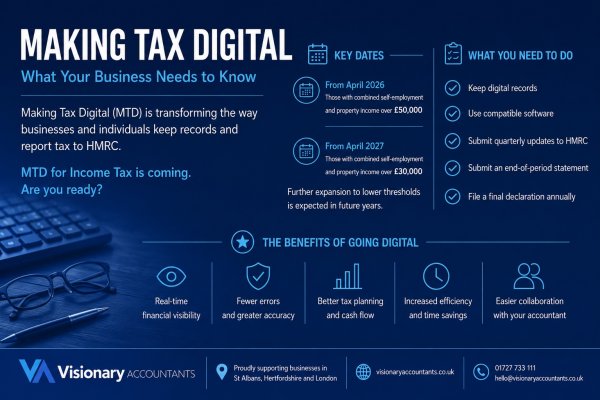
From April 2026
Individuals with combined self-employment and property income above £50,000 will be required to comply.
From April 2027
The threshold reduces to £30,000.
Further expansion to lower income thresholds is expected in future years.
Why Making Tax Digital Matters for Local Businesses
Across St Albans, Harpenden, Radlett, Watford and Central London, many businesses still rely partly on spreadsheets, paper receipts or manual bookkeeping.
While these systems may have worked historically, they often create:
-
Inefficiencies
-
Duplicate data entry
-
Higher risk of errors
-
Poor visibility over financial performance
-
Last-minute tax stress
Making Tax Digital is accelerating the need for businesses to modernise their accounting systems.
However, there are also significant opportunities.
Benefits of Making Tax Digital
Although many businesses initially view MTD as an administrative burden, the long-term advantages can be substantial.
1. Improved Financial Visibility
Cloud accounting software allows business owners to see real-time financial information including:
-
Bank balances
-
Outstanding invoices
-
Profitability
-
VAT liabilities
-
Upcoming tax obligations
This can support better decision-making and cash flow management.
2. Reduced Errors
Manual bookkeeping increases the risk of:
-
Duplicate transactions
-
Missing expenses
-
Incorrect VAT treatment
-
Calculation mistakes
Digital systems help reduce these errors significantly.
3. Better Tax Planning
With quarterly reporting and real-time accounting data, businesses can:
-
Forecast tax liabilities earlier
-
Avoid year-end surprises
-
Plan for corporation tax and income tax more effectively
-
Improve budgeting
4. Increased Efficiency
Modern accounting systems can automate many routine processes, including:
-
Bank reconciliation
-
Invoice generation
-
Expense capture
-
Receipt storage
-
Payroll integration
This reduces administrative workload and frees up time for business growth.
5. Easier Collaboration With Accountants
Cloud-based systems allow accountants and clients to work together more efficiently.
Rather than exchanging spreadsheets or paper records, businesses can receive:
-
Real-time support
-
Ongoing tax advice
-
Faster year-end accounts preparation
-
Better business insights
For businesses in London and Hertfordshire, this often creates a more proactive relationship with their accountant.
Common Challenges Businesses Face
While the advantages are clear, many organisations still face practical challenges when moving to Making Tax Digital.
Choosing the Right Software
Not all accounting platforms suit every business.
Factors to consider include:
-
Business size
-
Industry sector
-
Number of users
-
Payroll requirements
-
VAT complexity
-
Multi-currency requirements
-
Integration needs
Professional advice can help avoid costly software mistakes - talk to us today.
Data Migration
Moving from spreadsheets or older systems to cloud accounting software can be complex.
Common issues include:
-
Incomplete records
-
Duplicate entries
-
VAT coding errors
-
Historical reconciliation problems
Careful setup is essential to ensure compliance and reporting accuracy - talk to us today.
Staff Training
Even the best accounting system will fail if staff are not properly trained.
Businesses often need support with:
-
Bookkeeping procedures
-
Expense management
-
Invoice processing
-
Digital record keeping
-
VAT workflows
Quarterly Reporting Adjustments
For many self-employed individuals and landlords, quarterly submissions will represent a significant change in working practices.
This may require:
-
More frequent bookkeeping
-
Better organisation of records
-
Regular financial reviews
-
Ongoing accountant support
Making Tax Digital for Landlords
Landlords across St Albans, Hertfordshire and London will also need to prepare for MTD.
This is particularly important because many landlords currently maintain relatively simple annual records.
Under MTD, landlords with qualifying income will need to:
-
Keep digital property income records
-
Submit quarterly updates
-
Use compatible accounting software
This applies to:
-
Single-property landlords
-
Portfolio landlords
-
Joint property owners
-
Furnished holiday lets
With rising compliance obligations already affecting landlords, early preparation is highly recommended - talk to us today.
How Businesses Can Prepare for Making Tax Digital
Preparation is the key to a smooth transition.
Review Existing Processes
Businesses should assess:
-
How records are currently maintained
-
Whether systems are digital
-
Where manual processes exist
-
Whether software is MTD compliant
Move to Cloud Accounting Software
Cloud accounting platforms are becoming essential for modern businesses.
Popular options include:
-
Xero
-
QuickBooks Online
-
Sage Business Cloud
-
FreeAgent
The right choice depends on the complexity and needs of the business. here at VA we work with Xero accounting software.
Improve Record Keeping
Good bookkeeping habits are critical under MTD.
Businesses should aim to:
-
Keep records updated regularly
-
Store receipts digitally
-
Reconcile bank accounts monthly
-
Categorise expenses correctly
-
Review reports consistently
Seek Professional Advice Early
Many businesses leave tax and accounting changes until the last moment.
However, early planning provides:
-
Better implementation
-
Reduced disruption
-
More efficient processes
-
Improved compliance
-
Lower long-term costs
Working with experienced accountants can make the transition far easier - talk to us today.
The Impact on Small Businesses in St Albans and Hertfordshire
St Albans has a strong and diverse business community, including:
-
Professional services firms
-
Retail businesses
-
Consultants
-
Construction companies
-
Technology startups
-
Property investors
-
E-commerce businesses
Many local SMEs are already embracing digital accounting, particularly those operating in London-facing industries where efficiency and real-time reporting are increasingly important.
However, smaller owner-managed businesses may still rely heavily on manual systems.
For these businesses, MTD presents an opportunity not just to comply with HMRC requirements, but to modernise operations and gain better financial control.
Why London Businesses Are Adopting Digital Accounting Faster
Businesses operating in London often face:
-
Faster growth
-
More complex reporting requirements
-
Greater competition
-
Higher administrative demands
As a result, many London businesses have accelerated their move towards cloud accounting and digital finance systems.
We are increasingly seeing businesses adopt integrated solutions that combine:
-
Accounting
-
Payroll
-
Expense management
-
Forecasting
-
Reporting dashboards
-
CRM integration
Making Tax Digital is helping drive this broader transformation.
The Future of Tax in the UK
Making Tax Digital is unlikely to stop with VAT and Income Tax.
HMRC’s long-term vision is a fully digital tax system with:
-
Real-time reporting
-
Increased automation
-
Greater integration between businesses and HMRC
-
Reduced manual submissions
Future developments may eventually include further digitisation of:
-
Corporation tax
-
Payroll reporting
-
Capital gains tax
-
Investment income reporting
Businesses that modernise early are likely to benefit most from these changes.
How an Accountancy Firm Can Help With MTD
A professional accountancy firm can support businesses throughout every stage of the MTD journey.
Typical services include:
Software Selection
Helping businesses choose the most appropriate cloud accounting platform.
Implementation Support
Setting up systems correctly from the outset.
Training
Providing staff training and ongoing support.
Bookkeeping and Compliance
Managing quarterly submissions and maintaining compliance.
Tax Planning
Helping businesses reduce liabilities and improve financial efficiency.
Business Advisory Services
Using real-time data to provide proactive business advice.
Key Takeaways
Making Tax Digital is one of the most significant changes to the UK tax system in recent years.
For businesses and landlords in St Albans, Hertfordshire and London, preparation is essential.
The key points to remember are:
-
MTD for VAT is already mandatory for most VAT-registered businesses
-
MTD for Income Tax begins from April 2026 for qualifying taxpayers
-
Digital record keeping is becoming essential
-
Cloud accounting software offers major long-term benefits
-
Early preparation reduces disruption and stress
-
Professional guidance can simplify implementation considerably
Final Thoughts
While Making Tax Digital introduces new compliance obligations, it also presents an opportunity for businesses to modernise their financial systems and improve efficiency.
Businesses that embrace digital accounting early often benefit from:
-
Better visibility over finances
-
Improved tax planning
-
Reduced administrative workload
-
Stronger financial decision-making
-
More scalable operations
For businesses across St Albans, Hertfordshire and London, the transition to digital accounting is becoming an increasingly important part of long-term business success.
Whether you are a sole trader preparing for MTD for Income Tax, a landlord reviewing your reporting obligations, or an SME looking to improve your accounting systems, proactive planning now can help ensure a smoother transition in the years ahead. Make your life easier and talk to Visionary Accountants today!